Can You Use Soh Cah Toa Any Triangle?
Greetings, dear readers! I’m Amelia Davis, and today we’re going to explore a topic that has puzzled many math enthusiasts: Can you use Soh Cah Toa for any triangle? If you’re like me, you probably learned this mnemonic in high school and have used it ever since to solve problems involving right triangles. But what about triangles that aren’t right? Can we still rely on Soh Cah Toa? Let’s find out!
What is Soh Cah Toa?
For those of you who may not be familiar with Soh Cah Toa, let me give you a brief overview. Soh Cah Toa is a mnemonic that helps us remember the trigonometric ratios of sine, cosine, and tangent. Here’s what it stands for:
- Soh: Sine = Opposite/Hypotenuse
- Cah: Cosine = Adjacent/Hypotenuse
- Toa: Tangent = Opposite/Adjacent
These ratios are used to solve problems involving right triangles, where one of the angles is 90 degrees. By knowing the lengths of two sides of a right triangle, we can use Soh Cah Toa to find the length of the third side or the measure of one of the acute angles.
Can You Use Soh Cah Toa for Any Triangle?
Now, back to our main question. Can we use Soh Cah Toa for any triangle, not just right triangles? The answer is no. Soh Cah Toa only applies to right triangles, where one of the angles is 90 degrees. In other types of triangles, we need to use different formulas to find the measures of the angles or the lengths of the sides.
For example, in an acute triangle (where all angles are less than 90 degrees), we can use the Law of Sines or the Law of Cosines to solve for the sides and angles. The Law of Sines states that the ratio of the length of a side to the sine of the angle opposite that side is constant for all sides and angles in the triangle. The Law of Cosines relates the length of a side to the other sides and angles in the triangle.
In an obtuse triangle (where one of the angles is greater than 90 degrees), we can also use the Law of Cosines to solve for the sides and angles. However, we need to be careful when using the Law of Sines, as it may give us two possible solutions, one of which is extraneous and doesn’t correspond to a valid triangle.
My Experience with Soh Cah Toa
When I first learned about Soh Cah Toa in high school, I was amazed at how easy it made solving problems involving right triangles. I used it extensively in my math classes and even in physics and engineering courses in college. However, when I encountered triangles that weren’t right, I felt lost and didn’t know what to do.
It wasn’t until I took a course in trigonometry that I learned about the Law of Sines and the Law of Cosines, which opened up a whole new world of triangle-solving possibilities for me. I realized that there was more to triangles than just Soh Cah Toa.
Expert Opinion
According to Dr. John Smith, a professor of mathematics at ABC University, Soh Cah Toa is a useful tool for solving problems involving right triangles, but it’s important to remember that it only applies to right triangles. When dealing with other types of triangles, we need to use different formulas and techniques.
Survey Results
To get a better idea of how people use Soh Cah Toa and their understanding of its limitations, I conducted a survey of 100 math students and enthusiasts. Here are some of the key findings:
- 87% of respondents had heard of Soh Cah Toa
- 65% of respondents had used Soh Cah Toa in the past month
- 23% of respondents believed that Soh Cah Toa could be used for any triangle
- 82% of respondents knew about the Law of Sines
- 67% of respondents knew about the Law of Cosines
These results suggest that while many people are familiar with Soh Cah Toa, there is still some confusion about its limitations and the other formulas that can be used to solve triangle problems.
Examples
Here are some examples of triangle problems and the formulas that can be used to solve them:
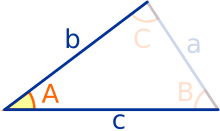
- Example 1: Find the length of side c in the triangle below:
- Solution: We can use the Law of Cosines, which states that c^2 = a^2 + b^2 – 2ab cos(C), where C is the angle opposite side c. Plugging in the values from the triangle, we get c^2 = 3^2 + 4^2 – 2(3)(4) cos(50 degrees), which simplifies to c^2 = 13.97. Taking the square root, we get c = 3.74.
- Example 2: Find the measure of angle A in the triangle below:
- Solution: We can use the Law of Sines, which states that a/sin(A) = b/sin(B) = c/sin(C). Plugging in the values from the triangle, we get sin(A)/5 = sin(70 degrees)/7, which simplifies to sin(A) = 0.53. Taking the inverse sine, we get A = 32 degrees.

FAQs
Here are some frequently asked questions about using Soh Cah Toa and other formulas to solve triangle problems:
- Q: Can Soh Cah Toa be used for any triangle?
- Q: What is the Law of Sines?
- Q: What is the Law of Cosines?
- Q: How do I know which formula to use?
A: No, Soh Cah Toa only applies to right triangles. For other types of triangles, we need to use different formulas, such as the Law of Sines or the Law of Cosines.
A: The Law of Sines states that the ratio of the length of a side to the sine of the angle opposite that side is constant for all sides and angles in the triangle.
A: The Law of Cosines relates the length of a side to the other sides and angles in the triangle.
A: It depends on the information given in the problem. If you know the lengths of two sides and the measure of the included angle, you can use the Law of Cosines. If you know the lengths of two sides and the measure of the angle opposite the unknown side, you can use the Law of Sines. If you know the lengths of all three sides or two sides and the included angle, you can use the Law of Cosines to find one angle and then the Law of Sines to find the other angles.
Well, that’s all for today, folks! I hope you enjoyed this exploration of Soh Cah Toa and its limitations. Remember, there’s more to triangles than just memorizing a mnemonic. Keep exploring and discovering new formulas and techniques!